Clause 3 – How to understand the definition of “protective electronic circuit”

protective electronic circuit: electronic circuit that prevents a hazardous situation under abnormal operating conditions.
NOTE Parts of the circuit may also be used for functional purposes.

With the advancement of technology, more and more electronic circuits are being used in household electrical products, and these electronic circuits are usually integrated on PCBs. They use microprocessor chips and their burned-in programmes to complete the established functions, which include some regular operating functions and also some protective functions, which are defined as prevents a hazardous situation under abnormal operating conditions.

Generally speaking, it is difficult to distinguish which part of the circuit is protective electronic circuit, usually we will first carry out the abnormal test in clause 19, through the test phenomenon to determine whether there is an electronic circuit involved in the protective function, if there is, we need to find out which part of the circuit is protective electronic circuit according to the circuit schematic diagram and the test phenomenon. If so, we need to find out which part of the circuit is protective electronic circuit according to the schematic diagram and the test phenomenon, which requires analysts to have basic knowledge of circuits. Annex Q (informative) Sequence of tests for the evaluation of electronic circuits gives a flowchart for the evaluation of electronic circuits and protective electronic circuits. clearer.
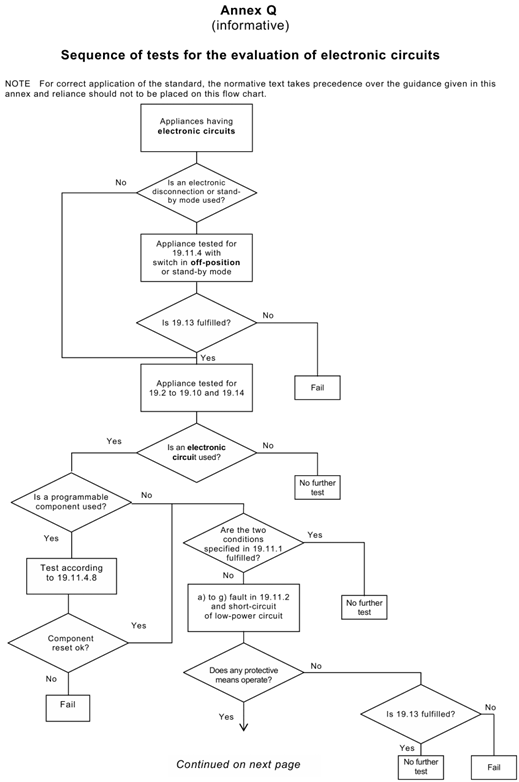
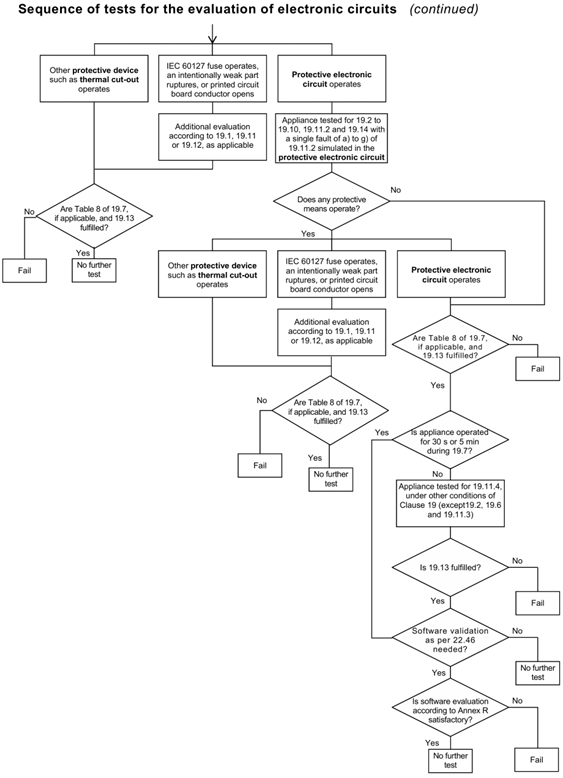
Annex Q

Similar Posts

  • ข้อ 3 – จะเข้าใจคำจำกัดความของ “อุปกรณ์คลาส III” ได้อย่างไร

    หมายเหตุ อาจจำเป็นต้องใช้ฉนวนพื้นฐานเพิ่มเติมจากการจัดหาที่ SELV อ้างถึง 8.1.4.คำว่า “ความปลอดภัย” รวมอยู่ในคำสี่คำ “ความปลอดภัยแรงดันไฟฟ้าต่ำพิเศษ” แต่ไม่ได้หมายความว่า SELV ปลอดภัย และไม่จำเป็นต้องปลอดภัยเมื่อสัมผัสโดยตรง เฉพาะวงจรไฟฟ้าแรงต่ำพิเศษด้านความปลอดภัยที่เป็นไปตามข้อกำหนดมาตรฐานข้อ 8.1.4 เท่านั้นที่สามารถสัมผัสได้โดยตรง เราจะวิเคราะห์และอธิบายสิ่งนี้โดยเฉพาะเมื่อวิเคราะห์ข้อ 8.1.4. พัดลมที่แสดงในภาพด้านล่างสามารถกำหนดเป็นอุปกรณ์คลาส III ได้ อย่างไรก็ตาม พัดลมชนิดนี้มีสองหู ซึ่งทำให้ไม่เป็นไปตามข้อ 22.44 เราจะอธิบายรายละเอียดในภายหลัง The word “safety” is included in the four words “safety extra low voltage”, but this does not mean that SELV is safe, and it is not necessarily safe to touch…

  • Clause 3 – How to understand the definition of “combined appliance”

    combined appliance: appliance incorporating heating elements and motors. We know that this standard mainly protects against the following five types of dangers, which are electric shock, mechanical damage from moving parts, thermal damage (such as burns), fire damage, chemical and biological damage. Generally speaking, thermal damage is caused by electric heating elements, and mechanical damage…

  • ข้อ 3 – วิธีทำความเข้าใจคำจำกัดความของ “กระแสไฟฟ้าที่ได้รับการจัดอันดับ”

    หมายเหตุ หากไม่มีการกำหนดกระแสไฟฟ้าให้กับเครื่องใช้ไฟฟ้า กระแสไฟที่กำหนดจะเป็น– สำหรับเครื่องทำความร้อน กระแสไฟฟ้าคำนวณจากกำลังไฟเข้าที่กำหนดและแรงดันไฟฟ้าที่กำหนด– สำหรับเครื่องใช้ไฟฟ้าที่ทำงานด้วยมอเตอร์และเครื่องใช้ไฟฟ้าแบบรวม กระแสไฟฟ้าที่วัดได้เมื่อจ่ายเครื่องใช้ไฟฟ้าด้วยแรงดันไฟฟ้าที่กำหนดและทำงานภายใต้การทำงานปกติ สิ่งนี้สอดคล้องกับกำลังไฟฟ้าเข้าที่กำหนด และถูกกำหนดในลักษณะเดียวกับกำลังไฟฟ้าเข้าที่กำหนด หมายเหตุแรกของข้อนี้ เครื่องทำความร้อน เนื่องจากมีเพียงองค์ประกอบความร้อนไฟฟ้าเพื่อให้ความร้อนเท่านั้น องค์ประกอบความร้อนนี้โดยพื้นฐานแล้วจะมีโหลดความต้านทานเพียงอย่างเดียว ดังนั้นคุณจึงสามารถปฏิบัติตามวิธีการคำนวณทางคณิตศาสตร์ได้โดยตรง เนื่องจากกระแสจะเท่ากับกำลังไฟฟ้าเข้าที่หาร โดยแรงดันไฟฟ้าที่กำหนด (P = U/I) หมายเหตุประการที่สอง เนื่องจากผลิตภัณฑ์ไม่ใช่โหลดที่มีความต้านทานเพียงอย่างเดียว ดังนั้นตามสูตรการคำนวณ P = U/I จึงไม่ได้ให้ผลลัพธ์ที่ถูกต้อง มีเพียงการทดสอบเพื่อให้ได้ค่าปัจจุบันเท่านั้นโดยทั่วไปมีบ้างเครื่องใช้ไฟฟ้าที่ทำงานด้วยมอเตอร์ มีป้ายระบุพิกัดกระแสในป้ายพิกัด เช่น ตู้เย็น เครื่องปรับอากาศส่วนใหญ่จะมีทั้งกำลังไฟเข้าพิกัดและกระแสไฟพิกัดบนป้ายพิกัด ฉลากจัดอันดับสำหรับตู้เย็น ป้ายเรตติ้งเครื่องปรับอากาศ rating label for air conditioner

  • Clause 3 – How to understand the definition of “motor-operated appliance”

    motor-operated appliance: appliance incorporating motors but without any heating elementNote 1 to entry: Magnetically driven appliances are considered to be motor-operated appliances. Household electrical appliances usually use heating elements or motors to complete their designed functions. The main functions are heating, such as heating food or air, and rotation or mechanical movement of products, such…

  • Clause 3 – How to understand the definition of “thermostat”

    thermostat: temperature-sensing device, the operating temperature of which may be either fixed or adjustable and which during normal operation keeps the temperature of the controlled part between certain limits by automatically opening and closing a circuit. The thermostat itself does not control the temperature, the thermostat senses the temperature and controls the temperature by switching…

  • Clause 3 – How to understand the definition of “electronic component”

    electronic circuit: circuit incorporating at least one electronic component. The standard references electronic circuits in clause 19.11, clause 19.11.1, and clause 22.5. These requirements are additional to those for electronic circuits. The standard recognizes that electronic circuits alone cannot provide adequate protection. Electronic circuits may be susceptible to interference and malfunction, or they may be…