Clause 3 – How to understand the definition of “protective electronic circuit”

protective electronic circuit: electronic circuit that prevents a hazardous situation under abnormal operating conditions.
NOTE Parts of the circuit may also be used for functional purposes.

With the advancement of technology, more and more electronic circuits are being used in household electrical products, and these electronic circuits are usually integrated on PCBs. They use microprocessor chips and their burned-in programmes to complete the established functions, which include some regular operating functions and also some protective functions, which are defined as prevents a hazardous situation under abnormal operating conditions.

Generally speaking, it is difficult to distinguish which part of the circuit is protective electronic circuit, usually we will first carry out the abnormal test in clause 19, through the test phenomenon to determine whether there is an electronic circuit involved in the protective function, if there is, we need to find out which part of the circuit is protective electronic circuit according to the circuit schematic diagram and the test phenomenon. If so, we need to find out which part of the circuit is protective electronic circuit according to the schematic diagram and the test phenomenon, which requires analysts to have basic knowledge of circuits. Annex Q (informative) Sequence of tests for the evaluation of electronic circuits gives a flowchart for the evaluation of electronic circuits and protective electronic circuits. clearer.
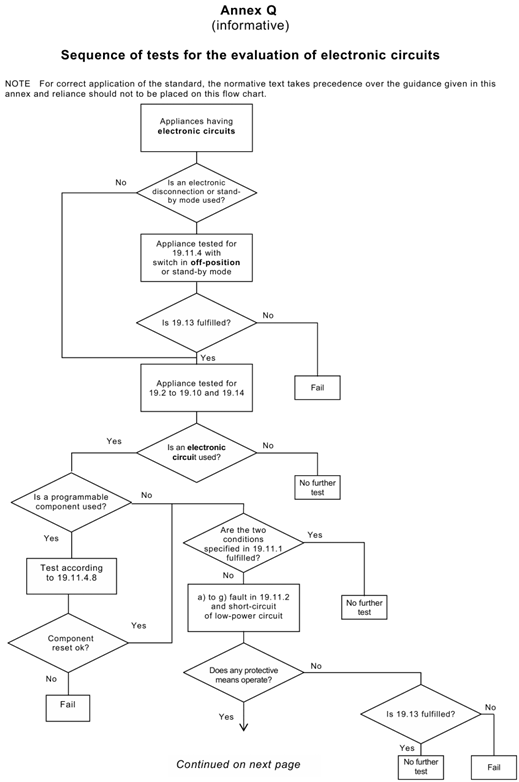
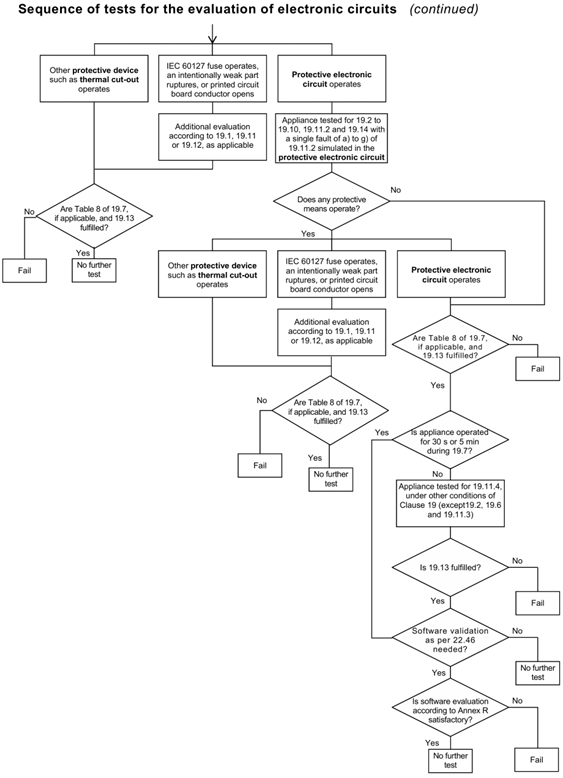
Annex Q

Similar Posts

  • Clause 3 – How to Understand the Definition of “visibly glowing heating element”

    visibly glowing heating element: heating element that is partly or completely visible from the outside of the appliance and has a temperature of at least 650 °C when the appliance has been operated under normal operation at rated power input until steady conditions have been established. The heating element needs to be able to emit…

  • 第 3 項 – 「クラス III 機器」の定義の理解方法

    クラスⅢ機器:感電に対する保護が安全特別低電圧の供給に依存しており、安全特別低電圧以上の電圧が発生しない機器注記 SELV での供給に加えて基礎絶縁が必要になる場合があります。 8.1.4を参照してください。 「安全特別低電圧」の4文字には「安全」という文字が入っておりますが、これはSELVが安全であるという意味ではなく、直接触れても安全であるとは限りません。規格 8.1.4 の要件を満たす安全特別低電圧回路のみに直接触れることができます。これについては、8.1.4 項を分析する際に具体的に分析して説明します。 下図に示すファンはクラス III アプライアンスとして定義できます。ただし、このファンには 2 つの耳があるため、第 22.44 条に準拠していません。詳細は後ほど説明させていただきます。 The fan shown in the figure below can be defined as a class III appliance. However, this fan has two ears, which makes it not compliant with clause 22.44. We will explain the details later.

  • 第3項 「第3種建築物」の定義の見方

    クラスⅢ構造:感電に対する保護が安全特別低電圧に依存しており、安全特別低電圧以上の電圧が発生しない機器の一部注記 SELV での供給に加えて、基礎絶縁が必要な場合があります。 8.1.4を参照してください。注 2 機器の主要部分が SELV で動作し、取り外し可能な電源ユニットと一緒に納入される場合、機器のこの主要部分はクラス I 機器またはクラス II 機器のクラス III 構造とみなされます。 アプライアンスはプラグイン可能なアダプター (保護接地なし) によって電力を供給され、アダプターとアプライアンスは一緒にユーザーに配送されます。アダプターとアプライアンスは合わせてクラス II アプライアンスとして判断されます。アダプターはクラス II であるため、これによって感電に対する保護のクラスが決まります。ただし、機器 – ファンのみはクラス III 構造、つまりクラス II 機器内のクラス III 構造です。 もちろん、スイッチ電源 PCB が機器に組み込まれており、このスイッチ電源 PCB が SELV 回路を提供できるという別の状況もあります。そして、SELV回路部分はクラスII構造となっております。 Of course, there is another situation, that is, a switch power supply PCB is embedded in the appliance, and…

  • 第3項 「第二種工事」の定義の見方

    ここで重点を置くのは、二重絶縁または強化絶縁の要件を満たすことができる機器の構造の一部です。したがって、クラス I アプライアンスにはクラス II 構造も含まれます。例:下図のオーブンでは金属シェルとプラスチック製スイッチノブが使用されています。使用者がスイッチノブに触れると、ノブは絶縁体でできているため接地できません。感電に対する保護はノブ自体の絶縁にのみ依存します。スイッチ内部の充電部とスイッチノブ軸間は基礎絶縁となっており、スイッチノブは補助絶縁を形成します。したがって、スイッチノブの位置はクラスII構造となります。    

  • Clause 3 – How to understand the definition of “built-in appliance”

    built-in appliance: fixed appliance intended to be installed in a cabinet, in a prepared recess in a wall or in a similar location. Here, because the appliance must be installed in a reserved position (usually a cubic space with only one side open), it is a fixed installation and can be regarded as a fixed…

  • 第 3 項 – 「クリアランス」の定義の理解方法

    クリアランス: 2 つの導電性部品間、または導電性部品と導電性部品間の空気中の最短距離アクセス可能な表面。 クリアランスは非常に重要な概念です。クリアランスを理解するには、完全に絶縁された物質はなく、空気も電気を通すことができるということをもう一度言う必要があります。電圧が非常に高い場合、電流は空気中に伝導します。雷雨時の落雷は、雷が空気中を伝導する典型的な例です。雷の電圧は非常に高いため、空気の非常に長い部分を突き破り、空気のこの部分が導電性になります。家電製品では、電圧は非常に低いですが、製品中には空気が多く含まれており、空気中にも電流が流れます。電圧が増加すると、電圧が空気を突き抜ける距離も長くなります。これにより、クリアランスの概念が生まれます。クリアランスの詳細な説明については、IEC 60664-1 (低電圧システム内の機器の絶縁調整 – パート 1: 原則、要件、およびテスト) を参照してください。 次の写真は電気的除去の経路をよく説明していると思います。 電圧の異なる2つの電極間や、充電部と電気製品使用者の手の間に隙間が生じる場合があります。上の写真の 2 つの電極を他の物体として想像するだけで済みます。 キー アクセス可能な発掘された金属部品 1 つ 2筐体3 接地されている金属部分4 出土した接近不可能な金属部分活電部 L1 と L2 は互いに分離されており、一部は開口部を備えたプラスチックの筐体で囲まれ、一部は空気に囲まれ、固体絶縁体と接触しています。構造内部にはアクセスできない金属が組み込まれています。金属カバーが 2 つあり、そのうちの 1 つはアースされています。絶縁クリアランスの種類基礎絶縁L1A L1D L2F 機能性絶縁体L1L2 補助絶縁DE FG 強化絶縁 L1K L1J L2I L1C 注記隙間 L1D または L2F が強化絶縁の隙間要件を満たしている場合、補助絶縁の隙間 DE または FG は測定されません。 L1CNOTE If the clearances L1D or…