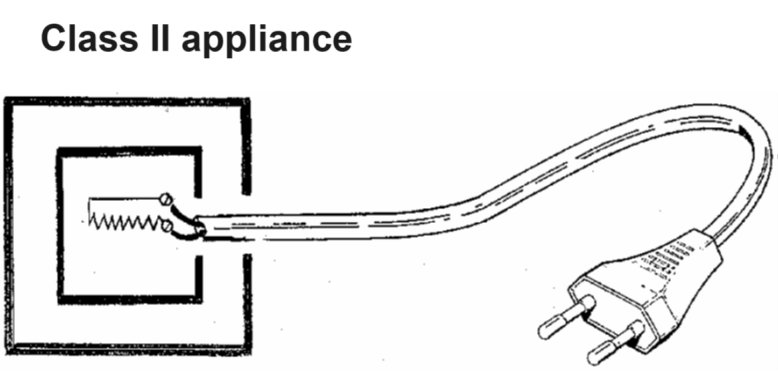
ฉนวนพื้นฐาน เฉพาะแต่โดยจัดให้มีมาตรการป้องกันความปลอดภัยเพิ่มเติม เช่น ฉนวนสองชั้น หรือ ฉนวนเสริมแรง ไม่มีข้อกำหนดสำหรับการต่อสายดินหรือการพึ่งพาเงื่อนไขการติดตั้งหมายเหตุ 1 อุปกรณ์ดังกล่าวอาจมีประเภทใดประเภทหนึ่งต่อไปนี้: – เครื่องใช้ไฟฟ้าที่มีเปลือกหุ้มที่ทนทานและต่อเนื่องกันมากเป็นวัสดุฉนวนซึ่งห่อหุ้มส่วนที่เป็นโลหะทั้งหมด ยกเว้นส่วนต่างๆ เช่น แผ่นป้าย หมุดเกลียว และหมุดย้ำ ซึ่งแยกออกจาก ส่วนที่ถ่ายทอดสด โดยฉนวนอย่างน้อยเทียบเท่ากับ ฉนวนเสริมแรง อุปกรณ์คลาส II– เครื่องใช้ไฟฟ้าที่มีเปลือกหุ้มโลหะที่ต่อเนื่องกันอย่างมาก โดยที่ ฉนวนสองชั้น; หรือ ฉนวนเสริมแรง ถูกใช้ตลอด; อุปกรณ์ดังกล่าวเรียกว่าเครื่องหุ้มโลหะ อุปกรณ์คลาส II – เครื่องใช้ไฟฟ้าที่มีฉนวนหุ้มอยู่รวมกัน อุปกรณ์คลาส II; และหุ้มด้วยโลหะ อุปกรณ์คลาส II หมายเหตุ 2 กรอบหุ้มของฉนวนหุ้ม อุปกรณ์คลาส II. อาจประกอบเป็นบางส่วนหรือทั้งหมด ฉนวนเสริม หรือของ ฉนวนเสริมแรง รูปที่ 11 – ตัวอย่างระยะห่างในมาตรฐาน IEC 60335-1 เป็นตัวอย่างง่ายๆ จากตัวเลขนี้ เราสามารถคิดถึงคุณลักษณะพื้นฐานของอุปกรณ์คลาส II โครงสร้างคลาส II อุปกรณ์คลาส I และการสร้างคลาส I reinforced insulation.
Here we think from the perspective of double precautions. In addition to basic insulation, the product also needs another layer of insulation, that is, double insulation measures to ensure that if any layer of insulation fails, there will be another layer of insulation to still play a protective role. The anti-electric shock effect of reinforced insulation is equivalent to double insulation in most cases, so it is also considered to be an effective way of double precautions. Class II appliances defined by the standard mainly emphasize that the appliance achieves the effect of double insulations through its own casing, insulated wires, and sheaths of insulated wires. Appliances with earthing measures are Class I appliances, so Class II appliances do not have protective earthing.
Except for Class 0 appliances, all appliances with large area plastic or insulating housings are generally designed as Class II appliances. However, there are also some motors with a metal housing, although the product can meet the requirements of Class II appliances, there is still a protective earthing measure on the motor. This appliance is considered a class I appliance. The notes to this clause give an introduction to the structural features of all possible Class II appliances.
Figure 11 – Examples of clearances in the IEC 60335-1 standard gives a simple example. Based on this figure, we can think about the basic characteristics of class II appliance, class II construction, class I appliance, and class I construction.
thermal link: thermal cut-out which operates only once and requires partial or complete replacement It is a temperature sensing device, but it can only be operated once, when the temperature is higher than its set value, it will disconnect, and after disconnection, the current can not pass through, so as to play the role of…
visibly glowing heating element: heating element that is partly or completely visible from the outside of the appliance and has a temperature of at least 650 °C when the appliance has been operated under normal operation at rated power input until steady conditions have been established. The heating element needs to be able to emit…
portable appliance: appliance that is intended to be moved while in operation or an appliance, other than a fixed appliance, having a mass less than 18 kg. This item is relatively easy to understand. Products that are less than 18kg are relatively light, so they are easy to move during operation, including humidifiers, fans, air…
off position: stable position of a switching device in which the circuit controlled by the switch is disconnected from its supply or, for electronic disconnection, the circuit is de-energized.NOTE The off position does not imply an all-pole disconnection. With reference to the content in the NOTE, both all-pole disconnection and single-pole disconnection are a stable…