Clause 3 – How to Understand the Definition of “off position”

off position: stable position of a switching device in which the circuit controlled by the switch is disconnected from its supply or, for electronic disconnection, the circuit is de-energized.
NOTE The off position does not imply an all-pole disconnection.

With reference to the content in the NOTE, both all-pole disconnection and single-pole disconnection are a stable condition of off position. So, what kind of electronic disconnection could be considered off position?
electronic disconnection, it could be achieved that the circuit is de-energized by relay, the circuit can also be disconnected by utilizing the switching function of a transistor, many other components capable of disconnecting circuits in a similar manner exist, though they will not be discussed here.

What we need to clarify is the difference between electronic disconnection and stand-by mode.

I checked standard IEC 335-1:1993 ED3.0, it gave us definitions below:
Off position: stable position of a switching device in which the circuit controlled by the switch is disconnected from its supply.
In the earlier version IEC 335-1:1976 ED2.0, the definition of “off position” was not yet established.

I searched the entire IEC 60335-1:2010+A1:2013+A2:2016 standard and found seven references to the “off position” within the document, like clause 7.10, clause 13.2, clause 16.2, clause 19.11, clause 19.13, clause 22.5, clause 22.55.
Particularly from the descriptions in clause 7.10 and clause 19.11, we can reasonably infer that electronic disconnection and stand-by mode should be considered as the off position. There is a word “circuit” in definition, it can be understood as the power supply circuit for the main energy-consuming components in the appliance, which excludes the electronic control circuits used for the PCB. As shown in the figure below, the content not highlighted by the red box corresponds to the “circuit” mentioned in the standard.
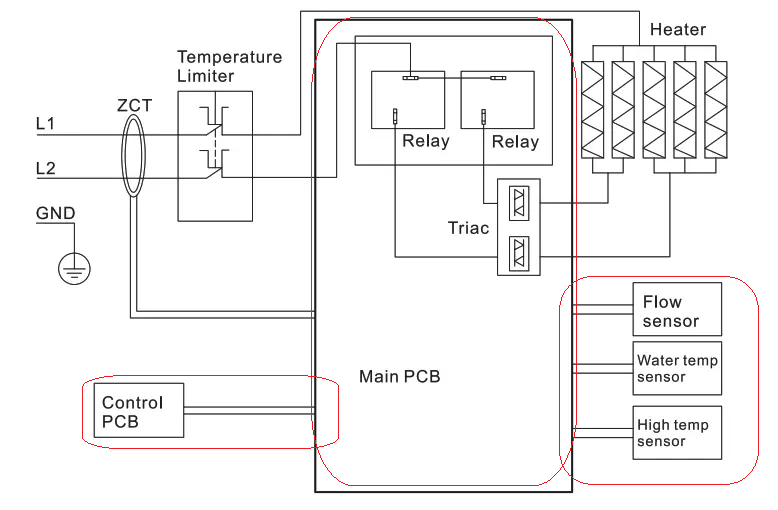
off position circuit diagram

Similar Posts

  • Why is the double limit allowed in clause 16.2?

    The statement of standard as below:The values specified above are doubled if all controls have an off position in all poles. They are also doubled if:– the appliance has no control other than a thermal cut-out; or– all thermostats, temperature limiters and energy regulators do not have an off position; or– the appliance has radio…

  • Clause 3 – How to understand the definition of “combined appliance”

    combined appliance: appliance incorporating heating elements and motors. We know that this standard mainly protects against the following five types of dangers, which are electric shock, mechanical damage from moving parts, thermal damage (such as burns), fire damage, chemical and biological damage. Generally speaking, thermal damage is caused by electric heating elements, and mechanical damage…

  • ข้อ 3 – จะเข้าใจคำจำกัดความของ “การทำงานปกติ” ได้อย่างไร

    การทำงานปกติ คือ สภาวะการทำงานตามวิธีที่ระบุไว้ในคู่มือการใช้งานตามปกติ บางครั้งก็เป็นสถานะของการทำงานในลักษณะที่ระบุไว้ในมาตรฐาน แม้ว่าโหมดการทำงานนี้จะไม่ได้อยู่ในคู่มือการใช้งานและโดยปกติผู้ใช้จะไม่ทำงานในลักษณะนี้ ในที่นี้ การดำเนินการตามปกติอาจมีการกำหนดใหม่ตามมาตรฐาน Part II ที่แตกต่างกัน มาตรฐานส่วนที่ 2 สำหรับตู้เย็น ตามมาตรฐาน โดยมีเงื่อนไขว่าสภาวะการทำงานปกติต้องล้างช่องเก็บของตู้เย็น ปิดลิ้นชักและประตูตู้เย็น ตลอดจนตั้งค่าการควบคุมอุณหภูมิที่ผู้ใช้ปรับเองให้ลัดวงจรหรือใช้งานไม่ได้ การทำงานปกติเป็นเพียงสภาวะการทำงานเดียวเท่านั้น และบางครั้งคำจำกัดความมาตรฐานของการทำงานปกติอาจมีจุดประสงค์เพื่อกำหนดสภาวะการทำงานที่รุนแรงที่สุดnormal operation is only one operating condition, and sometimes the standard definition of normal operation may be intended to set the harshest operating conditions.

  • ข้อ 3 – จะเข้าใจคำจำกัดความของ “การก่อสร้างประเภท II” ได้อย่างไร

    ตัวอย่าง: เตาอบที่แสดงในภาพด้านล่างใช้เปลือกโลหะและปุ่มสวิตช์พลาสติก เมื่อผู้ใช้สัมผัสปุ่มสวิตช์ ปุ่มทำจากวัสดุฉนวนและไม่สามารถต่อสายดินได้ การป้องกันไฟฟ้าช็อตสามารถพึ่งพาฉนวนของปุ่มเท่านั้น มีฉนวนพื้นฐานระหว่างชิ้นส่วนที่มีกระแสไฟฟ้าภายในสวิตช์และแกนปุ่มหมุนสวิตช์ และปุ่มหมุนสวิตช์จะสร้างฉนวนเสริม ดังนั้นตำแหน่งปุ่มสวิตช์จึงเป็นโครงสร้างคลาส II       

  • Clause 3 – How to understand the definition of “user maintenance”

    user maintenance: any maintenance operation stated in the instructions for use, or marked on the appliance, that the user is intended to perform. Allowed user-executed operations, the operation guideline was given in user manual, and it could be showed in enclosure of appliance. Since it is a allowed user-executed operation, then additional protective method should…

  • ข้อ 3 – วิธีทำความเข้าใจคำจำกัดความของ “ไฟล์แนบประเภท X, ประเภท Y, ประเภท Z”

    สิ่งที่แนบประเภท X: การเชื่อมต่อสายไฟเสร็จสมบูรณ์ในพื้นที่ที่เตรียมไว้เป็นพิเศษในเครื่องใช้ไฟฟ้า ดังนั้นเมื่อเปลี่ยนสายไฟจะไม่สัมผัสส่วนอื่นใดนอกจากแผงขั้วต่อและสายภายใน สกรูที่ยึดสายไฟเป็นสกรูหัวแฉกหรือหัวแบนธรรมดา การเปลี่ยนสายไฟให้ดำเนินการภายในช่วงที่ควบคุมได้ สายไฟที่ผู้ใช้ทั่วไปแทนที่นั้นค่อนข้างเรียบง่ายและใช้งานได้ การแนบประเภท Y: เมื่อเปลี่ยนสายไฟ โดยทั่วไปจำเป็นต้องเปิดโครงโครงสร้างของเครื่องใช้ไฟฟ้า และยึดตัวเรือนเหล่านี้ด้วยสกรูพิเศษ เช่น สกรูหกเหลี่ยม หลังจากเปิดโครงโครงสร้างของเครื่องแล้ว ชิ้นส่วนทดแทนอาจสัมผัสชิ้นส่วนที่เคลื่อนไหวที่เป็นอันตรายหรือชิ้นส่วนอื่นๆ ที่มีไฟฟ้าภายในเครื่องได้ ในกรณีนี้ จะปลอดภัยกว่าหากกำหนดการเชื่อมต่อเป็นเอกสารแนบประเภท Y และกำหนดให้ผู้เชี่ยวชาญเปลี่ยนสายไฟ โดยปกติแล้ว สกรูยึดจะเป็นสกรูธรรมดาที่ผู้ใช้ทั่วไปสามารถใช้งานได้ แต่หากสัมผัสชิ้นส่วนที่เป็นอันตรายได้ในระหว่างการเปลี่ยนสายไฟ โดยทั่วไปจะกำหนดให้เป็นสิ่งที่แนบมาประเภท Y ไฟล์แนบประเภท Z ดูคำอธิบายและตัวอย่างใน 3.2.6. type Z attachment, see the explanation and examples in 3.2.6.