Clause 3 – How to understand the definition of “thermal cut-out”

thermal-cut-out: device which during abnormal operation limits the temperature of the controlled part by automatically opening the circuit, or by reducing the current, and is constructed so that its setting cannot be altered by the user.

There are three key provisions here. First, the thermal cut-out is a heat-sensing element, second, it can only be actuated during abnormal operation, and third, it cannot be adjusted by the user. Meanwhile the definition mentions that its function is to limit the temperature, and it does so by opening the circuit or reducing the current. Usually, we would think that its function is to prevent the temperature from being too high, indeed, most of its function is to prevent the temperature from being too high; however, in my opinion it can also be used to prevent the temperature from being too low, for example, in refrigerators or air-conditioning products. However, when we look at the definition of self-resetting thermal cut-out, the standard actually wants to limit just the high temperature state.
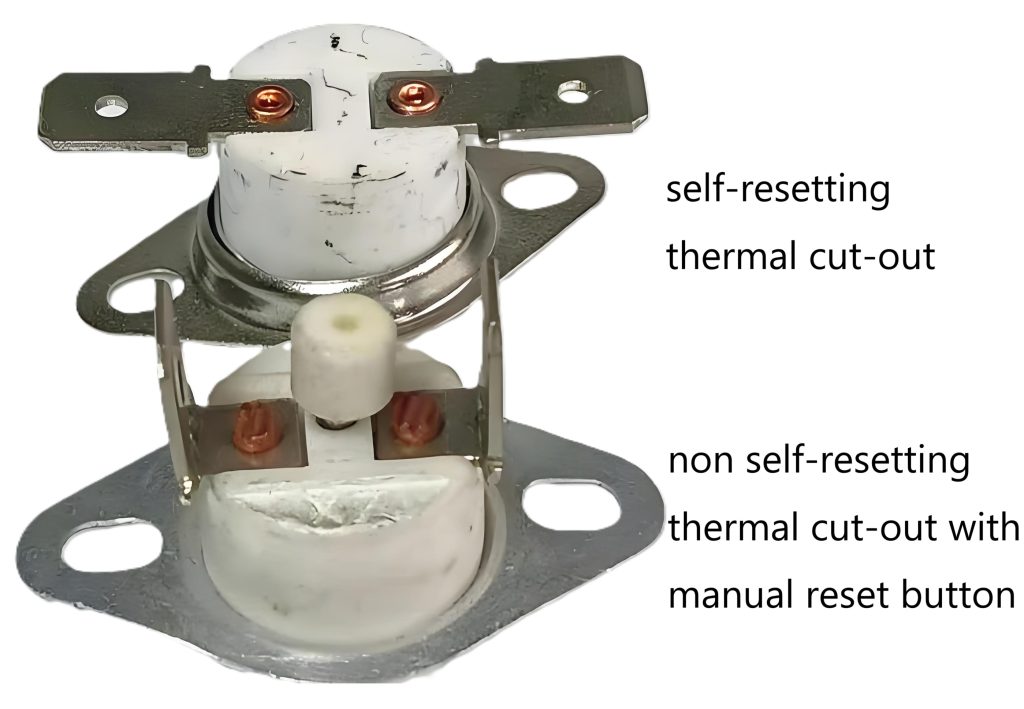
Thermal cut-out is a broad definition, which is subdivided into three categories of thermally sensitive protective devices, namely, self-resetting thermal cut-out, non-self-resetting thermal cut-out, and thermal link.
In normal operation, the component that operates may be a thermostat or temperature limiter, while in abnormal operation the component that operates is a thermal cut-out or a protective device.
Similar Posts

  • ข้อ 3 – วิธีทำความเข้าใจคำจำกัดความของ “อุปกรณ์คลาส 0I”

    เครื่องใช้ไฟฟ้ามีขั้วต่อสำหรับเชื่อมต่อตัวนำป้องกันภายนอก (ตัวนำสายดินป้องกัน) แต่ไม่มีสายไฟสำหรับเชื่อมต่อเครื่องใช้ไฟฟ้ากับตัวนำป้องกันในการเดินสายไฟแบบตายตัว เครื่องใช้ไฟฟ้าอาจมีสายไฟหรือโครงสร้างด้านในเพื่อส่งสัญญาณความต่อเนื่องของดิน ในญี่ปุ่น มีปลั๊กสำหรับอุปกรณ์คลาส 0I โดยเฉพาะ ดังที่แสดงด้านล่าง จากสิ่งที่ฉันเข้าใจ ปัจจุบัน มีเพียงญี่ปุ่นเท่านั้นที่ใช้อุปกรณ์คลาส 0I โดยปกติแล้วสายไฟจะมีสายดิน แต่การต่อลงดินไม่ได้กระทำโดยหมุดสายดินในปลั๊ก แต่จะใช้เครื่องมือในการเชื่อมต่อขั้วต่อหรือวงแหวนสายดินที่แยกจากกันเพื่อให้การต่อสายดินมีประสิทธิภาพ นอกจากนี้ ยังมีขั้วต่อสายดินบนอุปกรณ์ด้วย ก่อนการติดตั้ง ขั้วต่อนี้ไม่ได้เชื่อมต่อกับสายไฟภายนอกใดๆ และโดยปกติจะเชื่อมต่อระหว่างการใช้งานและการติดตั้ง From what I understand, at present, only Japan uses class 0I appliances. Usually, the supply cord have an earthing wire, but the earthing is not done by the earthing pin in the plug. Instead,…

  • Clause 3 – How to understand the definition of “PTC heating element”

    PTC heating element: element intended for heating consisting mainly of positive temperature coefficient resistors that are thermally sensitive and have a rapid non-linear increase in resistance when the temperature is raised through a particular range. As the temperature increases, the resistance of the heating element of the PTC heating element increases. The relationship between temperature…

  • Clause 3 – How to understand the definition of “thermostat”

    thermostat: temperature-sensing device, the operating temperature of which may be either fixed or adjustable and which during normal operation keeps the temperature of the controlled part between certain limits by automatically opening and closing a circuit. The thermostat itself does not control the temperature, the thermostat senses the temperature and controls the temperature by switching…

  • ข้อ 3 – จะเข้าใจคำจำกัดความของ “ฉนวนสองชั้น” ได้อย่างไร

    คำจำกัดความมีไว้เพื่อให้คำอธิบายฉนวนพื้นฐานและฉนวนเสริมในมาตรฐานง่ายขึ้นเท่านั้น โดยใช้ชื่อเดียวเพื่ออธิบายสองชื่อ ดังแสดงในรูปด้านล่าง สายไฟมีฉนวนสองชั้น ปลอกลวดด้านในและปลอกลวดสีดำด้านนอก ซึ่งหมายถึงฉนวนสองชั้น ตามที่แสดงในภาพสองภาพต่อไปนี้ (พัดลม) ปลอกสายไฟภายในในภาพด้านซ้ายเป็นฉนวนพื้นฐาน และแผ่นด้านล่างของปลอกด้านนอกเป็นฉนวนเพิ่มเติม รูปภาพแผงวงจรต่อไปนี้มีเอฟเฟกต์ภาพเคลื่อนไหว ด้านขวาของเส้นประเป็นส่วนที่เข้าถึงไม่ได้โดยมีแรงดันไฟฟ้าใช้งาน 220-240V และด้านซ้ายของเส้นประเป็นส่วนที่เข้าถึงได้โดยมีแรงดันไฟฟ้าใช้งานสูงสุด 24V (สมมติว่าโครงสร้างอยู่ที่ตำแหน่งของเส้นประ มีคุณสมบัติตรงตามข้อกำหนดของฉนวนสองชั้นหรือฉนวนเสริม) เพื่อให้มั่นใจถึงการแยกที่มีประสิทธิภาพ โดยทั่วไปแล้ว สายไฟทางด้านขวาของเส้นประ (สายภายในสีแดงและสีน้ำเงิน) ไม่สามารถสัมผัสสายไฟภายในที่ค่อนข้างบางทางด้านซ้ายได้ ปลอกสายไฟของสายไฟด้านขวาเป็นฉนวนพื้นฐาน เนื่องจากปลอกสายไฟสัมผัสโดยตรงกับชิ้นส่วนที่มีไฟฟ้า และเป็นชั้นแรกของการป้องกันสำหรับชิ้นส่วนที่มีไฟฟ้า เปลือกลวดของลวดด้านซ้ายสามารถกำหนดได้ว่าเป็นฉนวนเสริมเท่านั้น แต่จะเป็นไปตามข้อกำหนดสำหรับฉนวนเสริมในข้อ 29.3 หรือไม่ จะต้องวิเคราะห์เมื่อแนะนำข้อ 29.3 ควรสังเกตไว้ที่นี่ว่าเปลือกลวดของเส้นลวดด้านซ้ายไม่สามารถกำหนดเป็นฉนวนพื้นฐานได้ และเปลือกลวดของเส้นลวดด้านขวาไม่สามารถเป็นฉนวนเสริมได้It should be noted here that the wire sheath of the left wire cannot be defined as basic insulation, and the wire sheath…

  • Clause 3 – How to understand the definition of “portable appliance”

    portable appliance: appliance that is intended to be moved while in operation or an appliance, other than a fixed appliance, having a mass less than 18 kg. This item is relatively easy to understand. Products that are less than 18kg are relatively light, so they are easy to move during operation, including humidifiers, fans, air…