Clause 3 – How to Understand the Definition of “off position”

off position: stable position of a switching device in which the circuit controlled by the switch is disconnected from its supply or, for electronic disconnection, the circuit is de-energized.
NOTE The off position does not imply an all-pole disconnection.

With reference to the content in the NOTE, both all-pole disconnection and single-pole disconnection are a stable condition of off position. So, what kind of electronic disconnection could be considered off position?
electronic disconnection, it could be achieved that the circuit is de-energized by relay, the circuit can also be disconnected by utilizing the switching function of a transistor, many other components capable of disconnecting circuits in a similar manner exist, though they will not be discussed here.

What we need to clarify is the difference between electronic disconnection and stand-by mode.

I checked standard IEC 335-1:1993 ED3.0, it gave us definitions below:
Off position: stable position of a switching device in which the circuit controlled by the switch is disconnected from its supply.
In the earlier version IEC 335-1:1976 ED2.0, the definition of “off position” was not yet established.

I searched the entire IEC 60335-1:2010+A1:2013+A2:2016 standard and found seven references to the “off position” within the document, like clause 7.10, clause 13.2, clause 16.2, clause 19.11, clause 19.13, clause 22.5, clause 22.55.
Particularly from the descriptions in clause 7.10 and clause 19.11, we can reasonably infer that electronic disconnection and stand-by mode should be considered as the off position. There is a word “circuit” in definition, it can be understood as the power supply circuit for the main energy-consuming components in the appliance, which excludes the electronic control circuits used for the PCB. As shown in the figure below, the content not highlighted by the red box corresponds to the “circuit” mentioned in the standard.
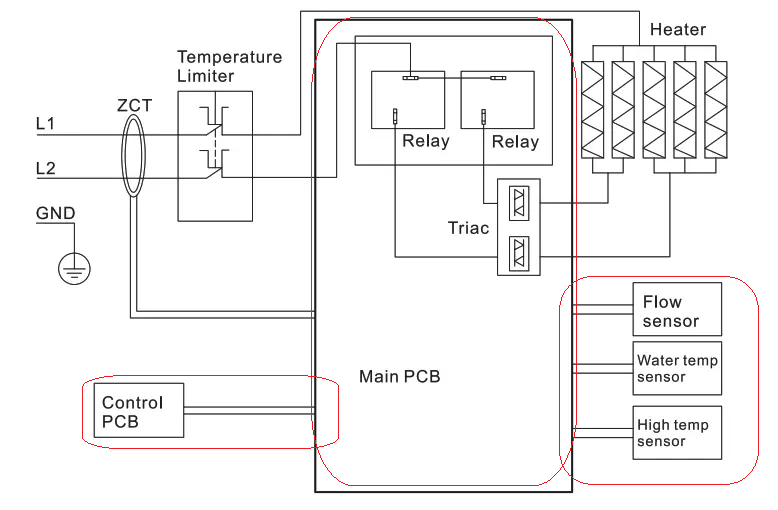
off position circuit diagram

Similar Posts

  • Clause 3 – How to understand the definition of “protective extra-low voltage circuit”

    protective extra-low voltage circuit: earthed circuit operating at safety extra-low voltage which is separated from other circuits by basic insulation and protective screening, double insulation or reinforced insulationNOTE 1 Protective screening is the separation of circuits from live parts by means of an earthed screen.NOTE 2 A protective extra-low voltage circuit is also known as…

  • 第3項「機能絶縁」の定義の見方

    機能的絶縁: 電位の異なる導電性部分間の絶縁であり、機器が適切に機能するためにのみ必要です。 下の図は典型的な機能絶縁の図です。PCB の銅レール層の図に示されているように、ラベルの茶色の部分は電源活線 (電流ヒューズ間に接続されている 2 つの茶色の位置)、青色の部分です。接続は電力線の中性線であり、活線であり、中性線には 2 つの線の間に電圧差があるため、選択した銅線レールの青色の部分と選択した銅線レールの茶色の部分の間の最短距離になります。レール、つまり機能絶縁体です。実際、通常の動作では、下の写真の回路基板、銅レール上の電圧は多くの場所で同じではないため、機能絶縁の形成により、読者は動作電圧によって独自の回路分析を行うことができます。各部分。 AC 非同期モーターの一般的な巻線接続図は次の図のようになります。図のコンデンサが動作しているとき、コンデンサの両端の電圧は通常、製品の定格電圧よりも高くなります。たとえば、定格電圧が 220V の場合、動作中にマルチメータで測定されるコンデンサの両端の電圧は通常 300V を超えます。このとき、コンデンサの両端間の機能絶縁を評価する場合、300V以上の使用電圧を基準に評価する必要がありますが、実際にはコンデンサ自体の機能絶縁は一般的には可能ではありません。コンデンサの端子がコンデンサのケース内に封入されているため測定されます。測定できる箇所はコンデンサの2本のリード線の端子台です。 下図に示すように、端子台には左側に活線が接続され、右側に中性線が接続されています。赤い線の位置は機能絶縁体の沿面距離です(クリアランスもここで決定できます)。 下の図に示されているキャリパーの測定値は、PCB 上のアダプターの入力のライブ銅線と中性銅線の間の機能絶縁を表しています。 As shown in the figure below, the terminal block has the live wire connected on the left and the neutral wire connected on the right. The position of the red line is the creepage distance of the…

  • Clause 3 – How to Understand the Definition of “Intentionally Weak Part”

    intentionally weak part: A part intended to rupture under abnormal operating conditions to prevent the occurrence of a condition that could impair compliance with this standard.NOTE: Such a part may be a replaceable component, such as a resistor or capacitor, or a part of a component to be replaced, such as an inaccessible thermal link

  • Clause 3 – How to understand the definition of “electronic component”

    electronic circuit: circuit incorporating at least one electronic component. The standard references electronic circuits in clause 19.11, clause 19.11.1, and clause 22.5. These requirements are additional to those for electronic circuits. The standard recognizes that electronic circuits alone cannot provide adequate protection. Electronic circuits may be susceptible to interference and malfunction, or they may be…

  • 第3項 「定格電流」の定義の見方

    定格電流: メーカーによってアプライアンスに割り当てられた電流。注: アプライアンスに電流が割り当てられていない場合、定格電流は次のようになります– 暖房器具の場合、定格入力電力と定格電圧から計算された電流; – 電動器具および複合器具の場合、器具が定格電圧で供給され、通常の動作で動作したときに測定される電流 この条項の最初の注意事項である暖房器具は、加熱用の電気発熱体のみを使用するため、この発熱体は基本的に純粋な抵抗負荷であるため、電流は入力電力を割ったものに等しいため、数学的計算方法に直接従うことができます。定格電圧による(P = U/I)。 2番目の注意点は、この製品は純粋な抵抗負荷ではないため、式によると、P = U/Iの計算では正確な結果が得られず、電流値を取得するテストのみが必要です。一般的には一部電動器具 冷蔵庫などの定格ラベルには定格電流と表示されています。ほとんどのエアコンの定格ラベルには、定格入力と定格電流の両方が記載されています。 冷蔵庫の定格ラベル エアコンの定格ラベル rating label for air conditioner

  • 第3項「基礎断熱」の定義の見方

    基本絶縁: 感電に対する基本的な保護を提供するために通電部分に適用される絶縁 一般的に言えば、充電部と直接接触する絶縁層は、一般的な絶縁材料 (PVC や ABS などのプラスチック材料など) である場合もあれば、空気または絶縁層上に形成された距離 (沿面距離) である場合もあります。断熱材の表面。ほとんどの国では、ユーザーが基礎断熱材に触れる可能性のある構造は認められていません。したがって、基礎絶縁は通常、機器の内部に配置されており、通常の動作中に触れることはできません。 下の左の写真は扇風機の底カバーの写真、右の写真は底カバーを外した写真です。右の写真の電源コード内の青と茶色のワイヤ外皮は、基本絶縁と考えることができます。同時に、黒いシェルに接続されているスイッチの白、赤、黒の線の外皮も基礎絶縁であると判断できます。ここでの充電部分は、ワイヤ内の銅芯です。また、スイッチ内の金属導体と白色シェル内面との距離により基礎絶縁性と判断できます。沿面距離の観点から見ると、スイッチ内の導体の電気は、スイッチの絶縁表面に沿って白いシェルの内面 (右の図の左の小さい角) まで伝導 (登って) します。この距離は、基礎絶縁体の沿面距離とみなしてください。電気的クリアランスの観点からは、スイッチ内部の導体の電気はファンボトムカバー内面とスイッチシェルの間の空気を介して直接伝導しており、この空気間の距離が基礎絶縁のクリアランスと判断されます。 (白いプラスチックシェルは追加絶縁と判断されます) 下図に示すように、モーターの巻線のラッカー塗装された導体は、モーターのステーターに挿入された白いスロット紙によって固定されています。巻線は規格により露出充電部として識別されます。ラッカー塗装された巻線の導体とモーターのステーターは、スロット ペーパーを介して導電ループを形成します (一般に、クラス I 機器の場合、モーター ハウジングが接地されているため、モーター ハウジングに接続されているステーターも接地されます。クラス II 機器では、モーター ハウジングとモーター ステーターは接地されていない中間金属コンポーネントです)。スロット紙の導電性は十分ではありませんが、スロット紙には微弱な電流が発生します。ここで発生する電流量はスロット紙の性能に直結します。ここでのスロット紙の材質は基礎絶縁体と判断できます。スロット ペーパーの表面は巻線の金属積層板に接続できるため、スロット ペーパーの表面上の距離は基礎絶縁体の沿面距離として決定できます。スロットペーパーの材質自体が固体絶縁の役割を果たします(固体絶縁には厚さの要件はありませんが、それでも第 13 章と第 16 章の漏れ電流と耐電圧要件を満たす必要があります)。したがって、上図の電気的クリアランスは、空中での巻線と固定子の積層間の最短距離です。 下の図に示すように、注意: モーターの巻線が適切に固定されておらず、モーターのステーターに非常に接近しています。第 29 条の沿面距離と空間距離の要件を満たすことができなくなりました。これは一般的な不適合項目です。 ファンモーターの基礎絶縁 basic insulation of fan motor