Clause 3 – How to understand the definition of “small part”

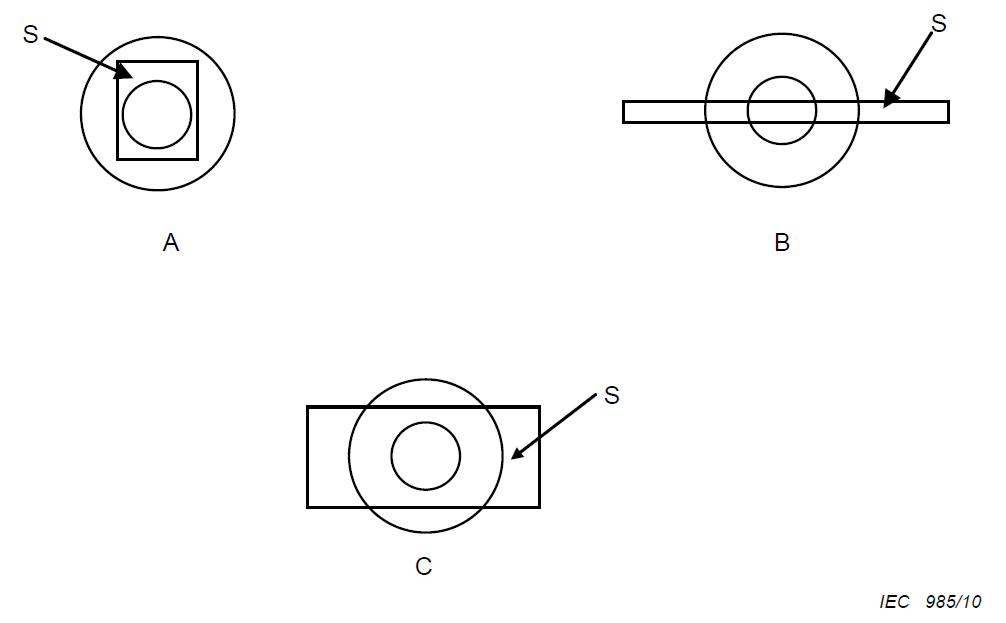
small part: part, where each surface lies completely within a circle of 15 mm diameter, or a part where some of the surface lies outside a 15 mm diameter circle but in such a way that it is not possible to fit a circle of 8 mm diameter on any of the surfaces.
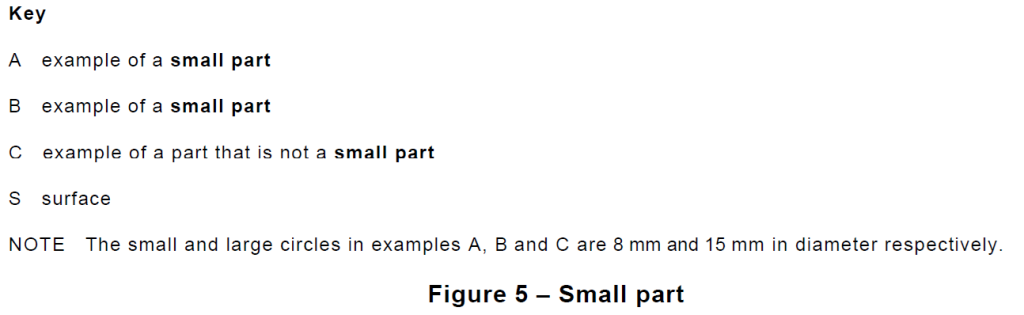
NOTE A part that is too small to grip and at the same time to be able to apply the glow-wire tip is shown in example A in Figure 5. A part that is large enough to grip but that is too small to be able to apply the glow-wire tip is shown in example B in Figure 5. A part that is not a small part is shown in example C in Figure 5.

The difference between small part and not a small part has been very well illustrated in Figure 5. Special attention should be paid here to the fact that every surface of the object needs to be considered when determining.
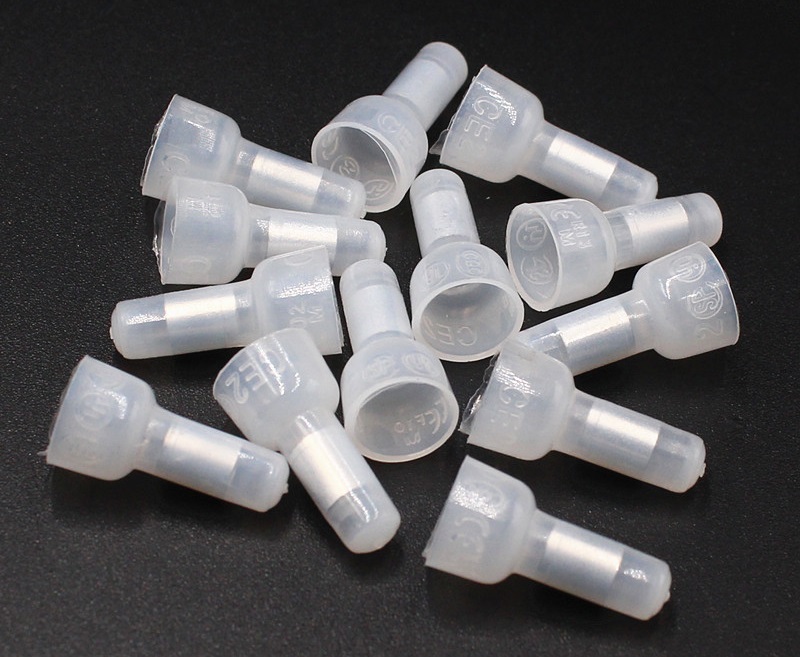
In the case of hollow structural members, or semi-hollow structural members, it is necessary to lay the parts out flat to make a determination.

A teat connector with a semi-hollow structure, as shown in the picture, is not a small part.
Similar Posts

  • Clause 3 – How to understand the definition of “non-self-resetting thermal cut-out”

    non-self-resetting-thermal cut-out: thermal cut-out that requires a manual operation for resetting, or replacement of a part, in order to restore the current.NOTE Manual operation includes disconnection of the appliance from the supply mains. The thermal cut-out is equipped with a temperature-sensitive component, typically a bimetallic strip or a thermistor, which reacts to heat. As the…

  • ข้อ 3 – วิธีทำความเข้าใจคำจำกัดความของ “อุปกรณ์คลาส 0I”

    เครื่องใช้ไฟฟ้ามีขั้วต่อสำหรับเชื่อมต่อตัวนำป้องกันภายนอก (ตัวนำสายดินป้องกัน) แต่ไม่มีสายไฟสำหรับเชื่อมต่อเครื่องใช้ไฟฟ้ากับตัวนำป้องกันในการเดินสายไฟแบบตายตัว เครื่องใช้ไฟฟ้าอาจมีสายไฟหรือโครงสร้างด้านในเพื่อส่งสัญญาณความต่อเนื่องของดิน ในญี่ปุ่น มีปลั๊กสำหรับอุปกรณ์คลาส 0I โดยเฉพาะ ดังที่แสดงด้านล่าง จากสิ่งที่ฉันเข้าใจ ปัจจุบัน มีเพียงญี่ปุ่นเท่านั้นที่ใช้อุปกรณ์คลาส 0I โดยปกติแล้วสายไฟจะมีสายดิน แต่การต่อลงดินไม่ได้กระทำโดยหมุดสายดินในปลั๊ก แต่จะใช้เครื่องมือในการเชื่อมต่อขั้วต่อหรือวงแหวนสายดินที่แยกจากกันเพื่อให้การต่อสายดินมีประสิทธิภาพ นอกจากนี้ ยังมีขั้วต่อสายดินบนอุปกรณ์ด้วย ก่อนการติดตั้ง ขั้วต่อนี้ไม่ได้เชื่อมต่อกับสายไฟภายนอกใดๆ และโดยปกติจะเชื่อมต่อระหว่างการใช้งานและการติดตั้ง From what I understand, at present, only Japan uses class 0I appliances. Usually, the supply cord have an earthing wire, but the earthing is not done by the earthing pin in the plug. Instead,…

  • ข้อ 3 – จะเข้าใจคำจำกัดความของ “ฉนวนสองชั้น” ได้อย่างไร

    คำจำกัดความมีไว้เพื่อให้คำอธิบายฉนวนพื้นฐานและฉนวนเสริมในมาตรฐานง่ายขึ้นเท่านั้น โดยใช้ชื่อเดียวเพื่ออธิบายสองชื่อ ดังแสดงในรูปด้านล่าง สายไฟมีฉนวนสองชั้น ปลอกลวดด้านในและปลอกลวดสีดำด้านนอก ซึ่งหมายถึงฉนวนสองชั้น ตามที่แสดงในภาพสองภาพต่อไปนี้ (พัดลม) ปลอกสายไฟภายในในภาพด้านซ้ายเป็นฉนวนพื้นฐาน และแผ่นด้านล่างของปลอกด้านนอกเป็นฉนวนเพิ่มเติม รูปภาพแผงวงจรต่อไปนี้มีเอฟเฟกต์ภาพเคลื่อนไหว ด้านขวาของเส้นประเป็นส่วนที่เข้าถึงไม่ได้โดยมีแรงดันไฟฟ้าใช้งาน 220-240V และด้านซ้ายของเส้นประเป็นส่วนที่เข้าถึงได้โดยมีแรงดันไฟฟ้าใช้งานสูงสุด 24V (สมมติว่าโครงสร้างอยู่ที่ตำแหน่งของเส้นประ มีคุณสมบัติตรงตามข้อกำหนดของฉนวนสองชั้นหรือฉนวนเสริม) เพื่อให้มั่นใจถึงการแยกที่มีประสิทธิภาพ โดยทั่วไปแล้ว สายไฟทางด้านขวาของเส้นประ (สายภายในสีแดงและสีน้ำเงิน) ไม่สามารถสัมผัสสายไฟภายในที่ค่อนข้างบางทางด้านซ้ายได้ ปลอกสายไฟของสายไฟด้านขวาเป็นฉนวนพื้นฐาน เนื่องจากปลอกสายไฟสัมผัสโดยตรงกับชิ้นส่วนที่มีไฟฟ้า และเป็นชั้นแรกของการป้องกันสำหรับชิ้นส่วนที่มีไฟฟ้า เปลือกลวดของลวดด้านซ้ายสามารถกำหนดได้ว่าเป็นฉนวนเสริมเท่านั้น แต่จะเป็นไปตามข้อกำหนดสำหรับฉนวนเสริมในข้อ 29.3 หรือไม่ จะต้องวิเคราะห์เมื่อแนะนำข้อ 29.3 ควรสังเกตไว้ที่นี่ว่าเปลือกลวดของเส้นลวดด้านซ้ายไม่สามารถกำหนดเป็นฉนวนพื้นฐานได้ และเปลือกลวดของเส้นลวดด้านขวาไม่สามารถเป็นฉนวนเสริมได้It should be noted here that the wire sheath of the left wire cannot be defined as basic insulation, and the wire sheath…

  • |

    If the PCB is sealed with solid sealant, how to determine the creepage distance and clearance?

    functional insulation as well as other insulation exists on circuit boards. Typically, the surface environment of a circuit board is determined to be either Pollution degree 3 or pollution degree 2.If the circuit board is mounted in an electrical box and sealed with a solid sealant, the sealing will look as follows: What should be…

  • ข้อ 3 – วิธีทำความเข้าใจคำจำกัดความของ “ช่วงกำลังไฟฟ้าเข้าพิกัด”

    คำจำกัดความนี้สอดคล้องกับช่วงแรงดันไฟฟ้าที่กำหนด ซึ่งหมายความว่ากำลังไฟฟ้าเข้าที่กำหนดจะมีป้ายกำกับเป็นช่วงขีดจำกัดบนและล่าง ตัวอย่าง: เครื่องทำความร้อนในห้องแบบหลอดควอทซ์ที่มีช่วงแรงดันไฟฟ้า AC220-240V และช่วงกำลังไฟเข้าพิกัด 2000-2200WExample: A quartz tube room heater with a rated voltage range of AC220-240V and a rated power input range of 2000-2200W.

  • Clause 3 – How to understand the definition of “heating appliance”

    heating appliance: appliance incorporating heating elements but without any motor. Before introducing this definition, we need to briefly introduce the electric heating elements commonly used in household electrical appliances. PTC heating element: PTC (Positive Temperature Coefficient) heating elements are widely used for various heating applications because of their self-regulating properties and safety features. Here are…